
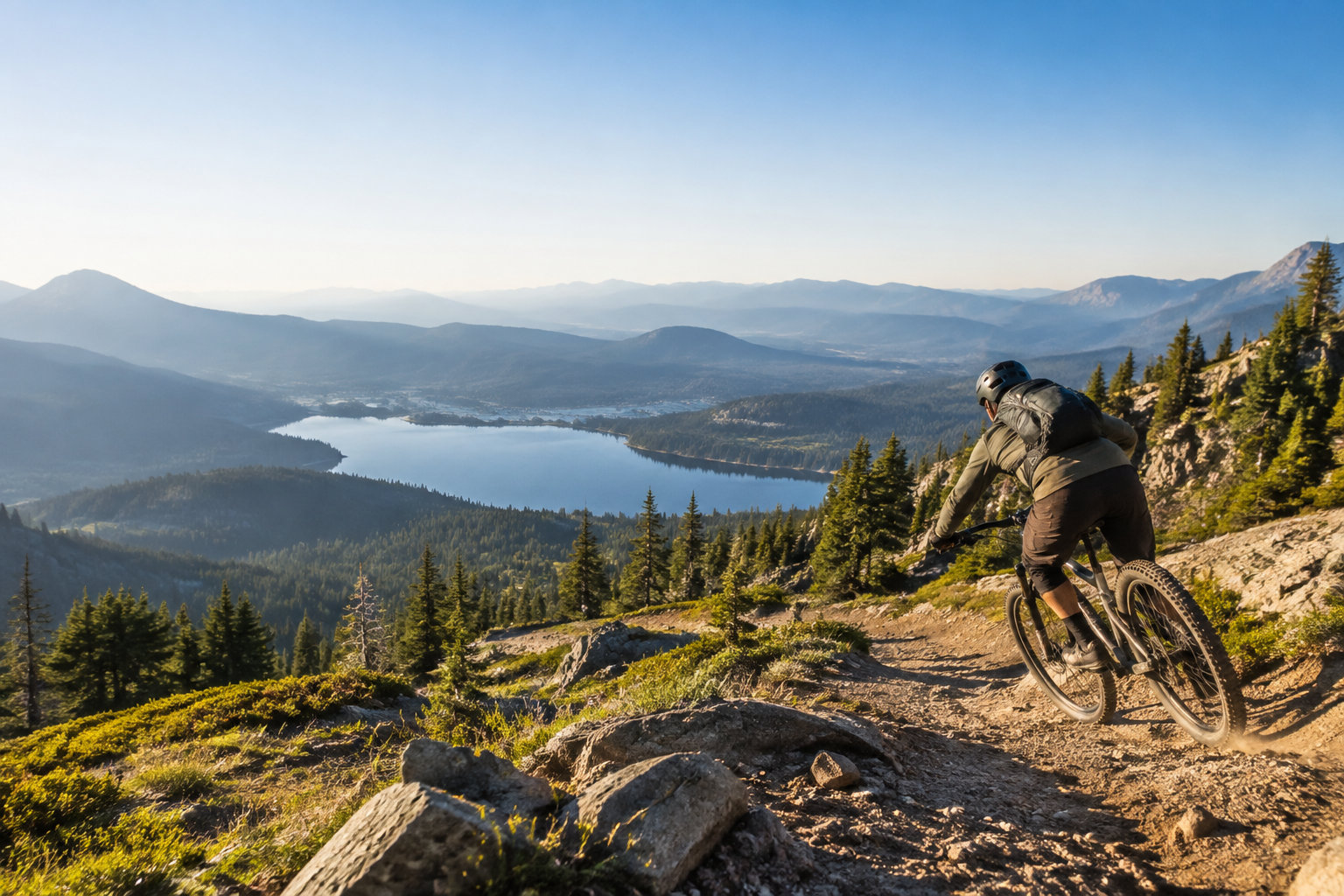
- Thunder Mountain is downhill only: you load your bike onto the lifts and ride back down, with no pedalling or hiking uphill on the trails.
- Trails are rated green, blue, black, double-black and Pro Line, and beginners usually aim to ride one full lap of Sugar Line, a long green route that drops about 900 feet.
- An adult weekday full-day lift ticket bought at the window costs US$61, and online purchases are cheaper but can sell out on busy dates.
- A helmet is mandatory and every rider must sign a waiver, with a parent or guardian required for riders under 18.
Contents
- Thunder Mountain Bike Park: Trails, Difficulty Levels and What to Expect
- Green, blue and black ratings show a clear path to progress
- Lessons and rentals set first-timers up for their first downhill run
- Lift tickets vary by day and channel, and October hours are shorter
- Berkshire East camping and Vermont trails for a longer trip
- Frequently asked questions
With 36 named trails, it’s easy to pick one far above your level. Choose too low and the day gets dull; choose too high and it gets dangerous.
This guide covers the trails, difficulty levels and what to expect at Thunder Mountain Bike Park.
Thunder Mountain Bike Park: Trails, Difficulty Levels and What to Expect
Getting to the park and riding the lifts
Thunder Mountain sits at Berkshire East Mountain Resort in Charlemont, Massachusetts. From Route 2, follow the signs for Berkshire East. Cross the Deerfield River and keep going to the base area.
That’s where you’ll find parking, the Welcome Center, the main lodge, the rental shop and the lift access.
This is a downhill-only park. You load your bike onto the T-Bar Express Quad or the Summit Quad. Then you ride back down on trails built for that purpose.
Pedalling or hiking uphill on the bike park trails is not allowed. There are no climbing routes here.
Trail count and checking conditions before you ride
The current list includes a range of named trails. They range from Sugar Line and Sugarcube to Fort Hill and Too Easy.
Before you pick a line, check the live conditions page. It shows which lifts and trails are open and the difficulty status for that day.
Heavy rain or strong winds can close trails and lifts.
Green, blue and black ratings show a clear path to progress
Matching a trail to your ability
Trails are rated green, blue, black, double-black and Pro Line. Weather, speed, fatigue and feature condition can all make a trail feel tougher than its rating.
Sugar Line is a long, forgiving green route with berms and small rollers. Sugarcube is a good place to practise braking and cornering.
Cat N’ Mouse is the blue flow option. It strings together repeated berms at a fast, smooth rhythm. It suits riders ready for tighter turns but not big jumps.
Gronk brings progressive tabletop jumps on blue. You can build your airtime one step at a time.
Billy Badger is the black technical choice. It mixes roots, rocks, steep turns and optional drops, with several line choices.
Cliff Clavin has steep sections, chutes and roots on double-black. Schist is narrow and steep, with very few flow features and technical riding throughout.
Hawleywood is the double-black jump trail. It has large tabletops, wooden drops and step-ups for experienced jumpers.
Fort Hill is the Pro Line trail. It has mandatory gaps, mandatory drops and large wooden features.
The resort suggests working your way through Gronk and then Hawleywood first.
Sugar Line runs about 3 miles and drops roughly 900 feet. It is a serious first run.
Take it easy at the start. Use the berms to control your speed, and treat the first lap as a skills check.
How the terrain actually rides
Thunder Mountain mixes machine-built flow with natural roots, rocks and steeper chutes. Flow trails reward smooth braking. Technical lines ask for careful line choice and frequent speed changes.
Before you ride an unfamiliar line, look at the entrance. Spot the ride-arounds and see where it rejoins other routes.
Features shift with the weather, maintenance, traffic and modifications. What you saw last time may not be exactly what’s there today.
Lessons and rentals set first-timers up for their first downhill run
Thunder Mountain 101 and skill preparation
Thunder Mountain 101 is the entry package for riders who already know how to ride a bike.
It includes a downhill bike, a full-face helmet, body armour, a lift ticket and a two-hour group lesson. The lesson covers body position, braking, shifting and cornering.
The usual goal is to ride one complete lap on Sugar Line. Quick learners may move on to some blue terrain, though not Gronk’s jump line.
The 101 package has a few conditions, and price comes first. An afternoon session costs between US$130 and US$180.
Full-day access costs between US$155 and US$180. The exact amount depends on age, day and holiday period.
Riders must be at least 10 years old.
Each rider can take only one package.
Timing matters too. You can’t ride the lift before the lesson. You collect your rental 15 minutes before it starts.
Private lessons and guiding are available for one to five riders of similar ability. The minimum age is six.
A half-day private session, lasting three hours, costs US$220 midweek.
On weekends and holidays, the same half day costs US$240.
A full-day private session, lasting six hours, costs US$400 midweek and US$420 on weekends and holidays.
Rental bikes and protective gear
You can book rentals online by date and rider. The shop gets the bike ready before you arrive. Every rental includes a helmet and pads, and you can add a lift ticket.
The DH Bike, a Scott Gambler 920, rents for US$110 for a half day and US$145 for a full day.
Premium DH bikes come as a Santa Cruz V10, a Transition TR11 or a Bottle Rocket. A half day on one costs US$130.
A full day on a premium DH bike costs US$160.
Premium enduro bikes include the Yeti SB165, the Transition Patrol and the Santa Cruz Nomad. A half day costs US$130.
A full day on one of these enduro bikes costs US$160.
The trail 27.5 bike, a Rocky Mountain Instinct in XS/S size, suits smaller riders.
Half days on it cost US$95, and full days US$110.
The youth bike, a Rocky Mountain Reaper or a Norco Fluid, rents for US$75 for a half day.
The youth bike rents for US$105 for a full day.
What your bike and body need
Every bike needs working front and rear brakes, all essential parts properly installed and a maximum tyre width of 3 inches.
The resort recommends disc brakes, at least 100 mm of suspension travel and a low saddle.
For this terrain, a downhill or enduro bike with 160 mm or more of travel is the better choice.
Riders must wear a helmet.
For more coverage, add a full-face helmet, gloves and eye protection. Knee and elbow pads, chest or back protection and sturdy shoes also help.
Every rider must sign a waiver. For riders under 18, a parent or legal guardian must complete it and the rental form.
Lift tickets vary by day and channel, and October hours are shorter
Ticket prices and where to buy
Lift ticket prices depend on the day, the duration and where you buy. Junior pricing applies to riders aged 18 and under. The listed prices don’t include tax.
A weekday full day ticket bought at the window costs US$61 for adults and US$46 for juniors.
On weekends and holidays, a full-day ticket costs US$80 for adults and US$52 for juniors.
A four-hour flex ticket is cheaper on weekdays, at US$55 for adults and US$35 for juniors.
Weekend and holiday four-hour flex tickets cost US$74 for adults and US$45 for juniors.
Buying online is cheaper than at the window. But ticket numbers can run short on busy dates.
You can reserve online, by phone at 413-339-6618, or at the Welcome Center.
Lift access runs on reloadable RFID cards.
New visitors, and riders replacing a lost card, pay US$5. They can pay online or at customer service.
Operating hours in October and November
From October 16 through October 31, the park is open on Fridays, Saturdays and Sundays.
On Fridays, it runs from 10 a.m. to 5 p.m.
Saturdays and Sundays open earlier, at 9 a.m., and close at 5 p.m.
Published November dates run from 9 a.m. to 4 p.m.
Arrive early enough to check in, collect your RFID card, sign any waiver still outstanding and pick up rental gear.
For a booked lesson, reach the Bike Shop on the main floor of the main lodge before the meeting time.
Berkshire East camping and Vermont trails for a longer trip
Berkshire East has basic camping near the bike park. You can pitch a tent in designated sections of the main parking lot, including oversized camping areas. The sites are mostly open fields with fire pits. There are no chairs or picnic tables, so bring your own.
For a longer trip, try Burke Mountain Bike Park and Kingdom Trails in Vermont. Burke has lift-served runs. Kingdom Trails is reached by pedaling from the trailhead.
Start with the green and blue trails, and let the ratings guide you before you try anything marked double-black. Book your rental online ahead of time, then check the live conditions page on the day you ride, since heavy rain or strong winds can close trails and lifts.
Frequently asked questions
What risks can you encounter while mountain biking at Thunder Mountain?
Mountain biking can involve falls, equipment damage, changing trail conditions and physical fatigue, especially on steep or technical terrain.
Lift tickets, rentals, gear and travel can also make a park day cost more than a free local trail.
What is the highest standard MTB trail rating?
On the common North American scale, double-black diamond ranks above black diamond. Thunder Mountain also has a Pro Line designation.
Fort Hill carries the Pro Line designation, with mandatory gaps, drops and large wooden features.
Can you walk your bike down a mountain bike trail?
Yes. If a feature is beyond your ability, you can walk your bike down the trail.
Stay visible, keep the trail clear and follow local signs. If you cannot ride a feature safely, walk your bike instead.