
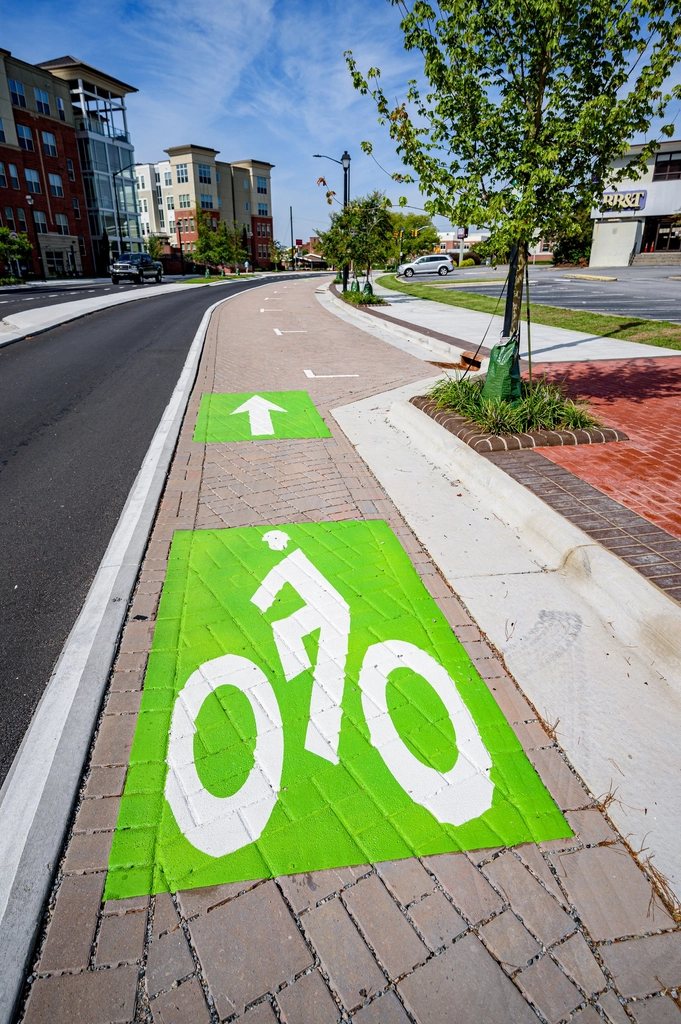
Not all bike lanes are created equal, and once you learn to read them you will never look at a street the same way. A white stripe next to a row of parked cars and a curb-separated lane behind a line of planters are both called bike lanes on a city map, but they offer very different levels of protection and attract very different riders. Here is a field guide to the main lane types, the numbers that define them, and what the research says about how much each one actually helps.
The painted lane
The conventional bike lane is a stripe of paint, a bicycle symbol, and an arrow. National design guidance calls for a minimum width of 5 feet, with 6 feet preferred on streets where traffic moves faster than 30 mph. On a constrained street you will sometimes see 4 feet, which is the legal floor in most places and feels like it. It costs very little, which is why it is the most common type in the country and the type you will find on most of our arterials.
What paint does is tell drivers where to expect you and give you a defined space. What it does not do is stop anything. A distracted driver drifts across paint with no resistance, and delivery vans use painted lanes as loading zones every day. Painted lanes work best on calm streets with speeds under 30 mph. On a 45 mph, five-lane arterial, a painted lane is better than nothing but will not get a nervous new rider out of the car.
The door zone
When a painted lane runs alongside parallel parking, there is a hidden hazard called the door zone. An open car door extends about 3 to 4 feet from the side of the car, and a 5 foot lane next to an 8 foot parking lane means that half or more of your lane is inside the swing of a door. Dooring crashes make up a meaningful share of urban bike injuries.
The fix on the rider’s side is to ride at the left edge of the lane, about 4 feet from parked cars, even if that puts you near the traffic line. The fix on the design side is a buffer strip between the parking and the bike lane, or better, a lane that puts the parked cars on the traffic side of the cyclists, which brings us to the next types.
Buffered and protected lanes
A buffered bike lane adds a painted striped zone, usually 2 to 3 feet wide, between the bike lane and traffic, parking, or both. The buffer costs almost nothing, and studies in several US cities have found riders position themselves more predictably and drivers pass with more room. A 5 foot lane with a 3 foot buffer is an 8 foot corridor, and on a street being repaved anyway it is just a matter of where the stripes go.
A protected bike lane, also called a separated bike lane or cycle track, puts a physical object between you and cars. That object can be a row of flexible plastic posts, a concrete curb, a line of planters, or the parked cars themselves shifted away from the curb. Design guidance calls for a one-way protected lane of at least 5 feet with 7 feet preferred, and a two-way lane of 10 to 12 feet. The parking-protected version is especially clever, because it uses the cars as a barrier and puts the door zone on the passenger side, where doors open far less often.
Protected lanes are what change who rides. Survey after survey finds that roughly 50 to 60 percent of adults say they are interested in cycling but concerned about safety, and physical separation is the single design feature that moves that group. Cities that have built networks of protected lanes have reported ridership increases of 20 to 170 percent on the affected corridors within a year or two.
Intersections and bike boxes
Most crashes happen at intersections, not mid-block, so how a lane handles a crossing matters as much as how wide it is. The oldest treatment is to simply end the lane before the intersection, which puts you back in mixed traffic exactly where the conflict is. Newer treatments are a big improvement.
- A bike box is a painted area, typically 10 to 16 feet deep, in front of the car stop line at a signal, letting cyclists wait ahead of traffic where drivers can see them and turn left without weaving.
- Green paint through the intersection marks the path cyclists will take and reminds turning drivers to look.
- A protected intersection uses corner islands to slow turning cars and give cyclists a setback crossing where drivers see them at a right angle instead of over their shoulder.
- A leading bicycle interval gives cyclists a green light 3 to 7 seconds before cars, so they are already through the crossing when the turning traffic starts.
The right hook, where a driver turns right across a cyclist going straight, is the crash we worry about most, and it is exactly what these treatments target. When you see a bike box, use it.
What the research says
The safety literature is large and the direction is consistent. Painted lanes reduce crash risk compared with no facility at all, by a modest amount that varies with the street. Buffered lanes do a bit better. Protected lanes with physical separation show the largest reductions, with several studies finding injury risk cut roughly in half compared with riding in mixed traffic on a major street, and the benefit grows when intersections are treated too. One widely cited study of a dozen large US cities found that the presence of protected bike infrastructure was associated with lower fatality rates not just for cyclists but for everyone on the road, because the same designs calm traffic overall.
There is a caveat. A protected lane with bad intersections can concentrate risk at the crossings, and a two-way lane on one side of a street creates a contraflow direction drivers do not expect. Sidewalk riding, for what it is worth, consistently shows up as more dangerous than any on-street facility because of driveway and intersection conflicts.
Reading your own streets
Next time you ride, notice what you are on. Notice whether there is a buffer, whether the parking is inside or outside you, and what happens at each signal. Then tell your city. Public comment on street projects is where these choices get made, and a room full of riders who can say why a 6 foot lane with a 3 foot buffer is better than a 4 foot stripe by a row of doors is a room that gets heard. The paint on our streets was decided by someone, and it can be decided again.