
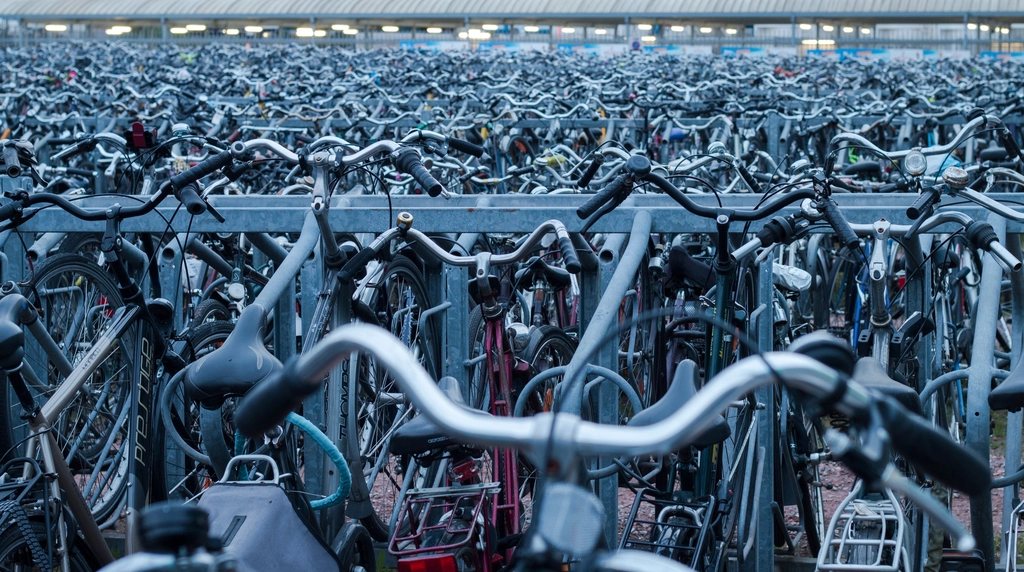
Ask anyone in our club why they drove somewhere instead of riding, and the answer is often not the distance or the weather. It is that there was nowhere to put the bike. A trip only works if it has a safe end, and a bike leaning against a window with a cable around the front wheel is not a safe end. Good bike parking is cheap, takes almost no space, and is one of the most reliable ways a city or a business can invite people to ride. Bad bike parking, which is most bike parking, quietly tells them not to.
The inverted U and why it wins
The best short-term rack is the simplest. An inverted U, sometimes called a staple or a hoop, is a single loop of 2 inch steel pipe rising about 33 to 36 inches from the ground and about 18 inches wide. It supports the bike at two points so it does not tip, and it lets you lock the frame and one wheel with a standard U-lock. Two bikes park per rack, one on each side. Variations like the post-and-ring work the same way. Anything that lets you lock the frame, not just a wheel, and holds the bike upright is in the right family.
Spacing is where most installations go wrong. Racks in a row should be at least 36 inches apart, center to center, so two bikes on neighboring racks do not tangle handlebars. Leave at least 24 inches between the rack and a wall, and 48 inches or more if the rack is parallel to a building so a bike can fit on the wall side. From the curb, keep 24 inches so a bike does not stick into the street or the door swing of a parked car. Set the rack in concrete with tamper-resistant bolts or embed it, because a rack that can be unbolted is a rack that walks off with the bikes attached.
What makes a rack useless
Walk around any commercial district and you will find racks nobody uses. They fail for predictable reasons, and most were bought in good faith by someone who never rides.
- The wheel bender, a comb of thin slots that holds only the front wheel, cannot secure the frame and tips the bike over when the wind blows.
- The wave rack, a long serpentine tube, is advertised for five bikes but fits two in practice because bikes lean and overlap.
- Racks placed 6 inches from a wall, blocked by a planter, or set in a corner so only one side is reachable.
- Racks behind the building next to the dumpster, out of sight of the entrance, where nobody wants to leave a bike and thieves have privacy.
- Racks made of thin tube or cheap bolts that a cordless grinder cuts through in 10 seconds.
The rule of thumb we give businesses is this: the rack should be within 50 feet of the main door, visible from inside, under a light, and lockable through the frame. If any of those is missing, riders will lock to the nearest signpost instead, and the rack becomes a decoration.
Corrals in car spaces
An on-street bike corral is a cluster of racks placed in a single parking space, protected from traffic by curbs or flexible posts. One car space, roughly 8 by 20 feet, holds 10 to 12 bikes on inverted U racks. That is a striking exchange rate, and it is why corrals have spread to hundreds of cities. They keep sidewalks clear for pedestrians, improve sightlines at corners when placed near a crosswalk, and sit right at the door of the shops that requested them.
Corrals work best in business districts with narrow sidewalks and steady bike traffic. Many cities have a program where a business asks for one and the city installs and maintains it, sometimes in exchange for the business keeping it swept. Removing a single car space is usually the only controversy, and the usual response from merchants after the first summer is to ask for a second one.
Lockers and long-term parking at transit
A rack is fine for two hours. A bike left at a bus stop or park and ride from 7 a.m. to 6 p.m., five days a week, needs more. Bike lockers are individual steel or composite boxes, about 6 feet long and 4 feet high, that hold one bike and keep it out of sight and out of the weather. Older models are rented by the month with a key. Newer electronic lockers can be opened on demand with a card or an app and charged by the hour, which lets one locker serve several riders a day instead of sitting empty when its renter is on vacation.
Some transit agencies build secure bike cages or rooms at major stations, a fenced enclosure with card access and cameras that holds 20 to 100 bikes at a fraction of the cost of lockers. If your local park and ride has only a wheel bender by the shelter, that is a specific and achievable thing to ask the agency to fix.
Workplace bike rooms
The best place to park a bike for the workday is inside the building where you work. A bike room needs surprisingly little: a secure door with keycard access, racks that hold the frame, and ideally a hook or two for wet jackets and a pump on the wall. Vertical racks that hang a bike by its front wheel roughly double capacity in a small room, with hooks 16 to 18 inches apart and staggered high and low so handlebars clear. Plan for about 2 percent of building occupants at a minimum, and more if you want the program to grow.
Building codes and zoning in a growing number of cities now require bike parking in new offices and apartments, often at a ratio of one long-term space per few units and one short-term rack per certain square footage of retail. Where the rules do not apply, a polite request to facilities usually works. A bike room and a shower have convinced more coworkers to try commuting than any pep talk we have ever given.
How to ask for better
Bike parking is the easiest infrastructure request a rider can make, because it is cheap, fast, and rarely political. An inverted U rack installed costs a few hundred dollars, a corral a few thousand. Most cities have a request form, and many will install a rack on public sidewalk in front of any business that asks. Take a photo of the useless rack, suggest where a proper one should go, and send it in. Then tell the shop owner you rode there. A bike locked to their front window is a customer, and once they see that, the next rack asks for itself.