
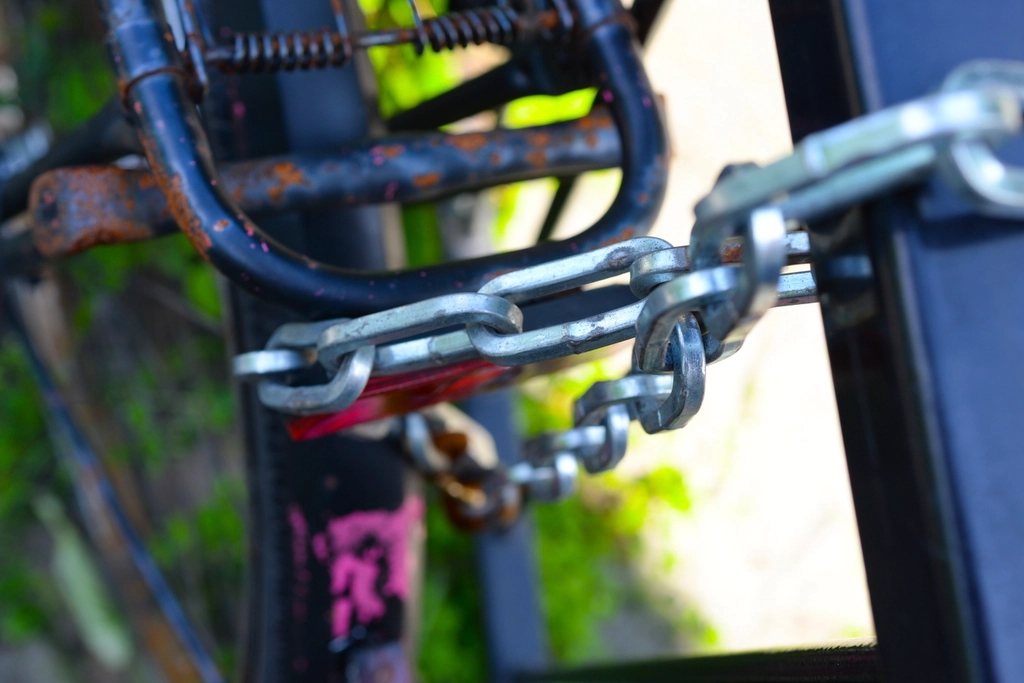
The worst text message in cycling is the one that says the bike is gone. We have all had a friend come out of a coffee shop, a grocery store or a movie and find a cut cable on the ground where their ride used to be. Bike theft in American cities is common, mostly unsolved, and almost entirely preventable with the right lock and five seconds of good technique. This is our club guide to keeping a bike in a city: which lock types actually resist tools, how to read the ratings, how to lock so that the thief moves on, and what to do before and after the day you hope never comes.
Where bikes actually get stolen
The pattern is boringly consistent. Around half of stolen bikes are taken from home, meaning a garage left open, a shared apartment bike room, a porch or a backyard. Another large share vanishes from the same places every day: transit stations, campus racks, the rack outside a gym, and any spot where a bike sits for eight hours in a row. Thieves look for routine. A bike locked in the same place at the same time every weekday is a bike someone can come back for with the right tool. Night is riskier than day, and a bike locked only by the front wheel, or with a thin cable, is the first one to go. Locking indoors at home matters as much as locking downtown.
U-lock, chain or folding lock
There are three serious lock designs and one that is not. A U-lock, also called a D-lock, is a hardened steel shackle 13 to 18 mm thick with a crossbar. It is the best value in theft resistance per dollar and per pound. The main weakness is that the shackle has to fit around the frame, wheel and a rack, so a small U-lock can be hard to use on a fat post. A chain uses hardened links of 10 to 14 mm and a padlock, wraps around anything, and is the choice for odd shapes and for leaving at a fixed location, but a chain that resists bolt cutters weighs 2 to 5 kg. A folding lock is a set of hinged steel plates that fold into a compact bar. It is easy to carry and flexible, but the plates and rivets are usually easier to defeat than a good U-lock of the same price. The fourth design, the cable lock, is not a lock against theft. Any cable can be cut in under a second with hand cutters that fit in a jacket pocket. Use a cable only as an add-on for a front wheel or a saddle, never on its own.
Reading Sold Secure and other ratings
The most widely used independent rating is Sold Secure, a testing scheme that grades locks as Bronze, Silver, Gold or Diamond. Bronze resists opportunist attacks with basic tools for a short time. Silver holds up against more determined attacks with a wider range of hand tools. Gold means the lock survived a sustained attack including a long test with heavy tools, and Diamond is the highest tier, intended for the most expensive bikes and e-bikes. Makers’ own numeric scales are fine within one brand but meaningless across brands. Our rule of thumb: a Silver-rated U-lock for a bike worth a few hundred dollars, Gold for anything you would be sad to lose, and Gold or Diamond for any e-bike, because it is worth more and attracts the thieves with power tools. Expect to pay 40 to 80 USD for a solid Silver U-lock, 80 to 150 USD for Gold, and more for Diamond or a heavy chain. Spend about ten percent of the bike’s value on the lock.
Locking technique in five seconds
A great lock used badly is a bad lock. The goal is to put the shackle through the frame, through the rear wheel inside the rear triangle, and around a fixed object, all at once. The rear wheel is worth three times the front, and passing the shackle inside the triangle means a thief cannot take the wheel without cutting the frame. Fill the shackle as much as possible so there is no room to fit a jack or a lever inside it. Keep the keyhole facing down so it is awkward to drill or fill. Then secure the front wheel with a second lock or a cable through the shackle. Choose the object with care: a bike rack that is bolted into concrete, a proper post, or a railing that does not end in an open top a bike can be lifted over. Check that the rack itself is not cut through and taped back together, a trick that is common in busy areas. Here is the short checklist we run through every time:
- Frame plus rear wheel plus solid object, all in one shackle.
- Shackle filled tight, keyhole down, off the ground.
- Front wheel secured with a second lock or a cable.
- Quick-release saddle and lights removed or locked.
- Visible, busy spot, not the dark side of the building.
Register the serial number today
Every bicycle frame carries a serial number, usually stamped under the bottom bracket where the pedals go through. Take a photo of it right now, along with a photo of the whole bike and your receipt if you have it. Then register the number in a national bike registry, which is free and takes five minutes. Police recover thousands of bikes each year that they cannot return because nobody can prove ownership, and those bikes end up at auction. A registry sticker on the frame is also a small deterrent, since a registered bike is harder to sell. Our club can help you do it at any of our monthly meetups.
Insurance and the day after
A renter’s or homeowner’s policy usually covers a stolen bike, but there is a deductible of 500 to 1000 USD and the payout may be depreciated value, which for a five-year-old bike can be close to nothing. If the bike is worth more than about 1500 USD, a dedicated bicycle policy costs roughly 100 to 300 USD a year, covers theft away from home, and pays replacement value. E-bike owners should check this carefully, because some home policies exclude motorized vehicles. If a theft happens, file a police report the same day with the serial number, mark the bike as stolen in the registry, and post it in local groups and marketplace listings with photos. A surprising number of bikes turn up for sale within a week, a few miles from where they vanished. Do not confront a seller alone; bring the police report and let them handle it. A good lock, a registered serial and a little routine variation will keep you on the right side of that text message.