
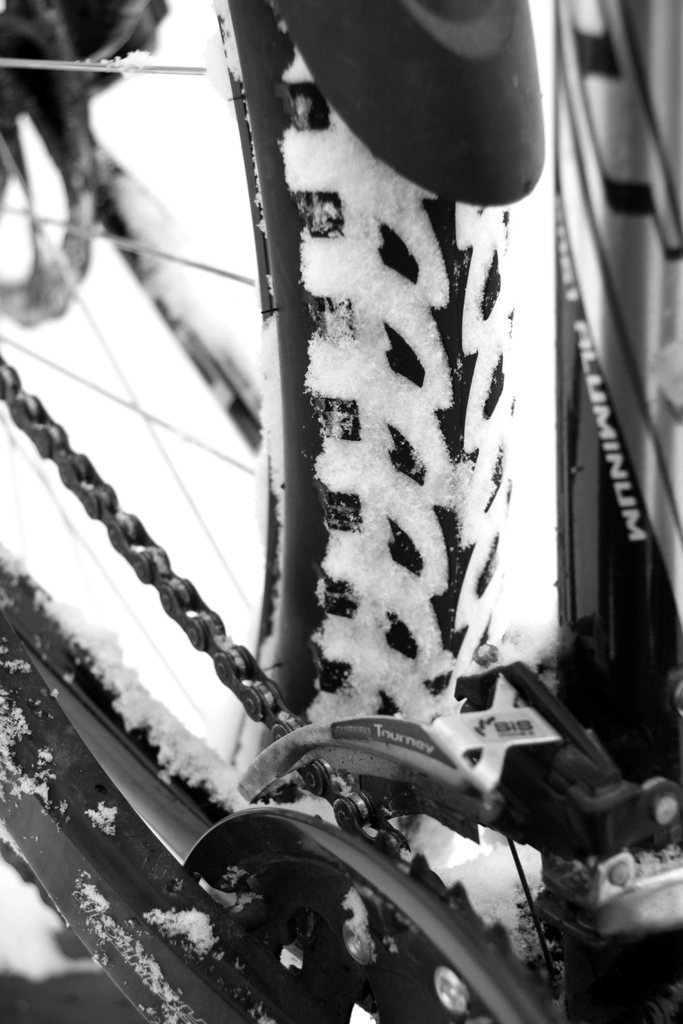
People who have never spent a winter in the Columbia Basin picture Washington as rain. We get about 7 inches a year, so rain is not the problem. The problem is a mix of freezing fog that can sit on the valley for a week, a southwest wind that arrives with no warning and stays for three days, and a stretch from mid-November to late January when you leave home in the dark and come back in the dark. None of that is a reason to hang up the bike. It is a reason to ride differently, and to know the few mornings a year when the right call is the bus.
Freezing fog and what it does to a road
The basin’s signature winter weather is a temperature inversion. Cold, damp air gets trapped under a lid of warmer air, and the fog that forms can last for days with temperatures hovering between 25 and 32 degrees. Visibility can drop below a quarter mile, and two things the fog does are dangerous. First, it deposits a thin film of ice, called rime, on every cold surface, including bike paths, bridge decks, and painted lines. Second, drivers cannot see you, and many of them are driving faster than the visibility justifies.
On fog mornings we treat every shaded stretch and painted crosswalk as slick. Slow down before corners, not in them, and if a stretch feels glassy, unclip and walk it without embarrassment. The path along the river is beautiful in fog and also the last place to thaw.
A bridge deck freezes before the road that leads to it, because cold air reaches it from above and below. Our river crossings are the coldest spots on any commute, and the pedestrian and bike decks on them are metal or concrete grating that ices first. When the overnight low is under 34 degrees and there was any moisture, assume the bridge is icy even if the road on both sides is dry. The same goes for underpasses and north-facing slopes. Black ice looks like wet pavement and does not feel like anything until the front wheel goes. If you must cross something questionable, stay off the brakes, keep the bars straight, and let momentum carry you. Lowering your tire pressure by 10 to 15 psi in winter widens the contact patch and helps more than most people expect.
Studded tires and whether you need them
For most Tri-Cities winters, a good wide tire with a soft compound and a bit of tread is enough, because we may only see a dozen genuinely icy mornings a season. If you commute every day regardless, or your route includes a shaded path or a bridge that stays icy for weeks, studded tires are worth it. A studded commuter tire carries between 100 and 250 small carbide studs, and even 100 studs on the front wheel alone makes a dramatic difference, since it is the front wheel washing out that puts you on the ground.
Studs are loud on dry pavement and add rolling resistance, so a lot of us keep a second front wheel with a studded tire mounted and swap it on when the forecast turns. That takes two minutes and avoids running studs on the 80 percent of winter days when the roads are just cold and dry.
Layering for 20 degrees and a headwind
The mistake every new winter rider makes is overdressing. If you are warm when you leave the house, you will be soaked in sweat within two miles, and wet is what makes you cold. The rule is to feel slightly chilly for the first five minutes. We build outfits in three layers and adjust for the wind rather than the thermometer alone.
- Base: a thin wicking layer, wool or synthetic, never cotton.
- Middle: a light fleece or wool jersey you can unzip on climbs.
- Shell: a windproof, water-resistant jacket with pit zips, because wind chill at 15 mph on a 25 degree morning feels like 10 degrees.
- Extremities: windproof gloves or bar mitts, a thin hat under the helmet, a neck gaiter you can pull over your nose in fog, and shoe covers or winter boots on flat pedals.
Fingers and toes are what end most winter rides. Bar mitts look odd and work better than any glove we have tried, and chemical warmers in the shoes are cheap insurance below 25 degrees.
The southwest wind
Our wind has a direction. It comes out of the southwest through the gap in the hills, and it can blow at 25 to 40 mph for a day or three at a time, usually ahead of a front. On a bike, a 30 mph crosswind on an exposed bridge or an open stretch of road is more dangerous than any ice, because it shoves you sideways into the lane or off the path edge. When the gusts are above 35 mph, we ride the sheltered route through neighborhoods even if it is longer, avoid the bridges, and keep both hands on the bars at all times.
The one gift of a wind with a fixed direction is that you can plan for it. Ride into it in the morning when you are fresh, let it push you home, and remember that a strong tailwind makes you faster than your brakes are ready for.
Lights, visibility, and the dark months
From late November to late January sunrise is after 7:30 and sunset is before 4:30, so both commutes happen in the dark or in fog that makes noon feel like dusk. State law generally requires a white front light and a red rear reflector or light after dark, but the legal minimum is not the point. We run a front light of at least 400 lumens on a steady beam so we can see the ice, a bright rear light on a flashing pattern, and a second small rear light on the helmet or bag as a backup, because batteries die in the cold. Reflective ankle bands catch headlights with the motion of your pedaling, which drivers notice more than a static vest.
When to take the bus
There is no prize for riding through everything. When there is fresh snow over ice, when the fog is under a quarter mile and the temperature is at or below freezing, or when gusts are above 40 mph, we take transit, and the buses here carry bikes so you can ride the far end of the trip. Most winters that is five or six mornings. The rest of the season, with the right tires, the right layers, and a healthy respect for bridges, is some of the quietest riding of the year. The river is steaming, the paths are empty, and you arrive awake in a way a car never delivers.